

Products

Manual Cast Ball Valve
Class: 150LB-600LB
Trunnion &Floating Ball, RB&FB
Send Inquiry
Product Introduction
Product Date:
Size: 1/2"-24"
Class: 150LB-600LB
Trunnion &Floating Ball, RB&FB
End connection: RF RTJ BW
Mode of operation: Lever, Gear box, Electric, Pneumatic, hydraulic device, Pneumatic-hydraulic device;
Design standard:
Design: ASME B16.34/API 6D
Face to Face: ASME B16.10 /API 6D
Flange: ASME B16.5/ ASME B16.47A
BW END: ASME B16.25
Test : API 6D
Anti-Fire : API 607/API 6FA
Acid environment: NACE MR 0175
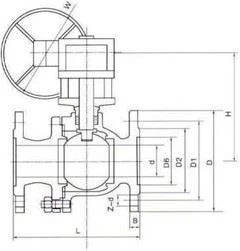
The manuel cast Ball Valve can be closed tightly only with a 90-degree rotation and a small torque. The completely equal internal cavity of the valve provides a straight flow channel with little resistance for the medium. It is generally believed that the ball valve is most suitable for direct opening and closing, but recent developments have designed the ball valve to throttle and control the flow. The main feature of the ball valve is its compact structure, easy operation and maintenance, suitable for general working media such as water, solvent, acid and natural gas, and also suitable for media with harsh working conditions, such as oxygen, hydrogen peroxide, methane and ethylene. The ball valve body can be integral or combined.
Application:

What Is Manual Cast Ball Valve?
A manual ball valve is primarily used for cutting off, distributing, and changing the flow direction of a medium (such as liquid or gas) within a pipeline. It consists of a rotary ball with a spherical perforated obstruction. The ball is positioned within a valve body. To control the fluid flow, the ball valve is rotated 90° (a quarter-turn) around its axis. When the hole in the ball aligns with the flow direction, the valve is open, allowing fluid to pass through. Rotating the ball to block the hole closes the valve, stopping the flow.
Manual ball valves are suitable for both liquid and gas services. They are widely used due to their reliability, long service life, and sealing effectiveness, including petroleum, chemical, and water supply systems.
Types of Manual Valves
Ball Valves
Ball valves offer very good shut-off capabilities. A simple quarter-turn (90°) completely opens or closes the valve. This characteristic minimizes valve operation time and decreases the likelihood of leakage due to wear from the gland seal.
Ball valves can be divided into two categories: reduced bore and full bore. In reduced bore valves, the valve opening is smaller than the diameter of the piping; in full bore valves, the valve opening is the same size as the diameter of the piping. Full bore ball valves are often valued because they minimize the pressure drop across the valve.
Butterfly Valves
In butterfly valves, the flow is regulated through a disc-type element held in place in the center of the valve by a rod. Similar to ball valves, valve operation time is short because the valving element is simply rotated a quarter turn (90°) to open or close the passageway.
Butterfly valves are characterized by their simple construction, lightness in weight, and compact design. Their face-to-face dimension is often extremely small, making the pressure drop across a butterfly valve much smaller than globe valves. Materials used for the valving element and sealing can limit their applications at higher temperatures or with certain types of fluids. Butterfly valves are often used in applications for water and air and in applications with large pipe diameters.
Globe Valves
The globe valve is suitable for use on a wide variety of applications, from flow rate control to open/close operation.
In this type of valve, flow rate control is determined not by the size of the opening in the valve seat, but rather by the lift of the valve plug (the distance the valve plug is from the valve seat). One feature of globe valves is that even if used in the partially open position, there is less risk of damage to the valve seat or valve plug by the fluid than with other types of manual valves. Among the various configurations available, needle type globe valves are particularly well suited for flow rate control.
Gate Valves
The construction of a gate valve is similar to that of a floodgate: flow is controlled by raising or lowering the valving element, which is generally available in three different types: solid (plain), flexible, and split. The latter two types help prevent the valving element and body from being deformed due to various operating conditions.
Like ball valves, gate valves are not usually used to regulate flow. One of the reasons for this is because the valving element can be damaged when in the partially open position. Similarly, they also limit the pressure drop across the valve when fully open. However, setting the valve to the fully open or closed position requires the handle to be turned many times, which generally makes these valves have the longest operating times among those valve types mentioned here.
Diaphragm Valves
Diaphragm valves use a 'pinching' method to stop the valve flow using a flexible diaphragm. They are available in two types: weir and straight-way. The most commonly seen of the two is the weir-type. This is because the straight-way type requires additional stretching of the diaphragm, which can shorten the diaphragm's life-span.
One of the major advantages of using diaphragm valves is that the valve components can be isolated from the process fluid. Similarly, this construction helps prevent leakage of the fluid without the use of a gland seal (packing) as seen in other types of valves. One the other hand, the diaphragm becomes worn more easily and regular maintenance is necessary if the valve is used on a regular basis. These types of valves are generally not suited for very high temperature fluids and are mainly used on liquid systems.
The Differences Between Forged Ball Valves and Manual Cast Ball Valves
- The compactness of the forged ball valve is relatively good. Owing to the complicated flow channel and appearance, it is impossible to form at one time. It often needs to be modularized, forged separately, and welded together. so the size of the forging is limited to a certain extent.
- Moreover, forgings usually cannot produce flexible streamlined runners. The runners are machined by turning. And many sharp corners are formed inside, which can easily lead to uneven stress and cracking. In the modular welded design, the seat diameter of the forged valve is relatively fixed, and in some valve sizes, the diameter is relatively small, affecting flow.
- Because of the limitation of the large valve forging process, in order to save cost, many manufacturers usually adopt the structure of valve body center casting and both end forging, so no matter casting or forging, there may be product defects during processing.
- The casting ball valves can be cast into large diameter ball valves, and castings have higher requirements on the casting process. They can be made into more complex shapes. For valve body structure and irregular flow channel, casting can be formed at one time. Therefore, the large diameter valve body can be cast at the high technology level.
- The main defects of cast ball valves are trachoma and bubbles. While the main defects of forgings are large grains, chill phenomenon, and cracks. In order to produce qualified products, the castings need heat treatment to eliminate the stress in the casting process. And at the same time, run tests with different inspection methods such as X-ray, magnetic particle inspection, and penetrant inspection. Besides, it is necessary to carry out strict heat treatment and corresponding inspection of the weld to forgings. Usually, ultrasonic inspection is required to ensure the quality of the product.
- Cast ball valves are used for large balloon valves (DN50 – 6.4MP). And forged ball valves should be used for those above DN50 and 6.4MP. For ball valves above DN50 and pressure above 6.4MP, forged ball valves can be used.
Frequently Asked Questions About Manual Cast Ball Valve
- 1. What is a cast steel trunnion mounted ball valve?
A cast steel trunnion-mounted ball is a type of valve used to control the flow or discharge of fluids, gasses, or oils. These valves are typically installed in pipelines and other fluid conduits. They are also used in industrial processes and as part of water distribution systems.
Cast steel trunnion-mounted ball valves are made out of a durable metal alloy. This alloy allows the valve to withstand high pressure and temperature conditions. The ball design allows for smooth operation and eliminates the need for pilot holes.
- 2.What is a cast valve?
Unlike forging, casting uses the liquid form of metal to create valves. These metals are melted into a molten liquid and poured into various molds.
- 3.What is the difference between cast and forged body in the process?
The difference between casting and forging comes down to the shaping process. Casting reduces metals to a molten form while forging shapes the metal workpiece while in a solid state.
- 4.What is a Type 2 ball valve?
Two-piece ball valves feature a main body with a single threaded end connection and a lever. They are also available with a bolt and flange connection assembly, as well as with larger port sizes.
- 5.What is an ANSI Flanged Ball Valve?
ANSI flanged ball valve is a full-bore ball valve with a flanged connection, designed for shut off and control flow. It is designed and manufactured according to ANSI B16. 34. ANSI flanged ball valve is available in stainless steel material and applicable to general water, oil, and gas applications.
- 6.What is the meaning of ANSI in valves?
ANSI means the American National Standards Institute
We are going to look into the types of ANSI valve standards, the features that define them, and how they affect how liquid materials are transported from one end to another.
- 7.What is the ANSI class rating of a valve?
The ANSI class of a valve refers to its pressure rating. The ANSI class number is composed of three digits and represents the valve's pressure rating in PSI. For example, a valve with an ANSI class of 150 means that it can handle up to 150 PSI (10 bar).
- 8.Are all ball valves manual?
No. All ball valves are available with pneumatic, electric, and manual operation.
- 9.What is the purpose of a manual valve?
Manual valves are those valves that operate through a manual operator (such as a handwheel or hand lever) and are primarily used to stop and start flow (block or on-off valves), and some designs can be used for basic throttling.
- 10.How to use manual ball valves or automatic ones?
Manual-type high-pressure ball valves can be operated by turning the lever 90 degrees. Motorized high-pressure ball valves are simulated through an electric signal for their operation.
- 11.Who controls the manual valve?
A manual valve is considered to be a valve that is operated by plant personnel directly, by the use of either a handwheel/wrench or an on/off actuator in the case of shutdown valves.
- 12.What is the most common example of a manual valve?
The ball valve is the most common example of a whole family of valves that include rotary valves, piston valves and other valves that use selective positioning of an inner core with one or more through-holes or cavities to direct flow from one or more inlet ports to one or more outlet ports.
- 13.Why do you need a ball valve?
Ball valves are recommended for applications that require frequent, quick control over the flow of liquid.
Hot Tags: manual cast ball valve, China manual cast ball valve suppliers, manufacturers, factory, dn10 ball valve with swivel, 4000 psi ball valve, 2 inch brass ball valve price, apollo 3 way ball valve, floating ball valve for arabian sea market, floating ball valve for arctic ocean market
Previous:
Flanged Floating Ball Valve
Send Inquiry


